


Does Pay Transparency Actually Help Workers?

Updated: Aug 1
Revealing salaries can help to reduce pay gaps, but is there a downside?

Takeaway: This paper synthesizes international economic research to evaluate how different types of pay transparency laws—peer-to-peer disclosures, managerial pay visibility, and salary ranges in job postings—reshape worker motivation, salary negotiations, and employer hiring strategies.
Key Points
Peer transparency shrinks wage gaps, but can lower overall pay: Making salaries visible among direct coworkers closes pay equity gaps, but employers frequently respond by bargaining harder and capping wages, reducing motivation for top performers.
Vertical transparency boosts worker motivation: Learning what bosses make reveals the financial rewards of promotion, encouraging higher effort in merit-based workplaces.
Cross-firm transparency empowers job seekers: Mandatory salary ranges in job ads reduce market confusion, driving underpaid workers toward higher-paying firms and forcing companies to compete on pay.
Why are job postings suddenly listing salary ranges? And if you found out your desk neighbor makes 20% more than you for the exact same job, would you get a raise—or would everyone’s salary end up capped?
Most people assume salary transparency is a straightforward win for workers. The logic seems clear: if employees know what their peers earn, underpaid workers can negotiate fairer pay or challenge illegal discrimination.
Driven by this idea, governments worldwide have passed pay transparency mandates aimed at closing gender and racial wage gaps.
However, labor markets are two-sided. While transparency changes what workers demand, it also changes how employers set wages and respond at the bargaining table.
Research
Harvard Business School professor Zoë Cullen analyzed economic theory alongside dozens of real-world studies evaluating pay transparency mandates across North America and Europe.
Rather than treating transparency as a single policy, the research categorizes it into three distinct types:
Horizontal transparency: Visibility into the pay of coworkers at the same level within the same firm.
Vertical transparency: Visibility into the pay of higher-ups across different tiers of authority.
Cross-firm transparency: Visibility into the salaries offered by competing employers and open job postings.
Using administrative payroll data, survey experiments, and job board disclosures, Cullen examined how each form of transparency alters employee expectations, workplace morale, and employer bargaining power.
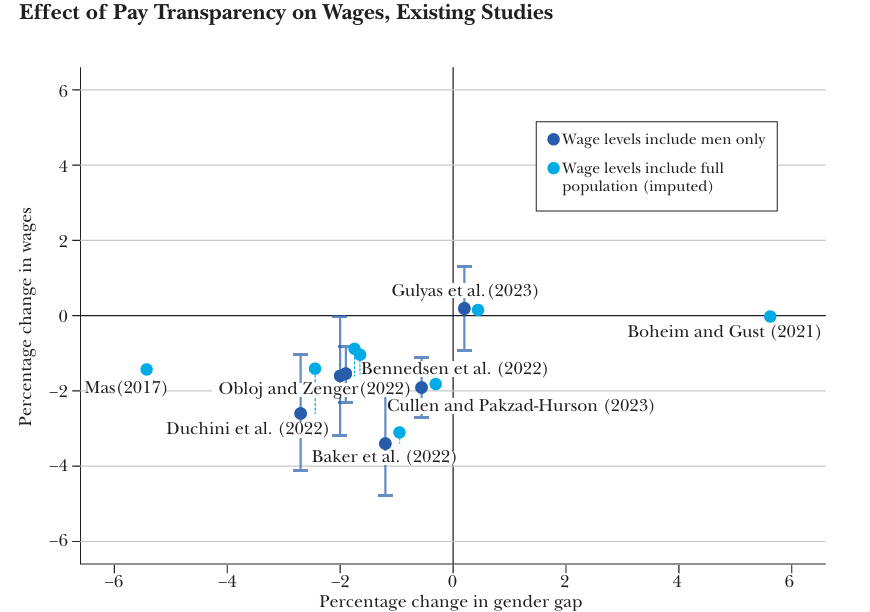
Chart depicting changes in wages and gender pay gap found in recent studies. Chart by Zoë Cullen
Findings
The evidence shows that the economic impact of pay transparency depends entirely on who gets to see whose paycheck.
When mandates enforce horizontal transparency—sharing pay data among peers—gender pay gaps do consistently narrow. However, overall average wages frequently stagnate or fall. Why? Under transparency, giving a $5,000 raise to one employee creates a spillover effect: other workers will discover it and demand equal treatment.
To avoid these costly spillovers, employers can "stiffen their backbone" during negotiations. They can wind up adopting rigid salary formulas and credibly claiming they cannot grant individual raises.
Furthermore, when peer pay gaps remain unaddressed, lower-paid workers report drops in morale and reduce their workplace effort.
In contrast, vertical and cross-firm transparency yield far more positive outcomes for workers. Employees systematically underestimate how much their managers earn. When vertical transparency reveals that promotions come with steep financial rewards, employees increase their effort and productivity, provided the workplace is meritocratic.
Cross-firm transparency—such as laws requiring salary ranges in job ads—reduces market confusion.
Unaware of what other firms pay, workers often anchor their expectations on their current salary. Disclosing pay scales allows underpaid workers to target higher-paying companies. For employers, seeing competitors' salary ranges sharpens market competition, forcing businesses to raise posted wages to recruit and retain talent.
Why It Matters
For policymakers and business leaders, this research shows that transparency is not a simple cure-all. If the goal is strictly to eliminate unjustified pay discrimination within a firm, peer disclosure laws work—though potentially at the cost of broader wage growth. But if the goal is to raise overall wages, boost productivity, and empower job seekers, policies promoting cross-firm disclosures and clear career pay structures offer a far more effective path forward.
Learn More
Paper Title: Is Pay Transparency Good?
Author: Zoë Cullen
Journal: Journal of Economic Perspectives
Publication Year: 2024
URL: https://www.aeaweb.org/articles?id=10.1257/jep.38.1.153
Econ Today Explains
Economic Concept: Monopsony Power
Monopsony power occurs when an employer has enough market leverage to set wages rather than accepting prevailing market rates. Under pay secrecy, employers can selectively offer higher pay to attract specific hires without adjusting everyone else's salary.
However, when peer pay transparency is enforced, granting one worker a raise forces the firm to pay all similar workers more. To avoid these broad wage increases, the employer adopts a single, rigid pay formula and refuses individual wage requests. Paradoxically, by making individual raises too expensive for the firm to grant, peer pay transparency grants the employer greater monopsony power—shifting bargaining leverage away from individual workers and suppressing overall wage growth.
This article was written by AI but reviewed by a real human.


Comments